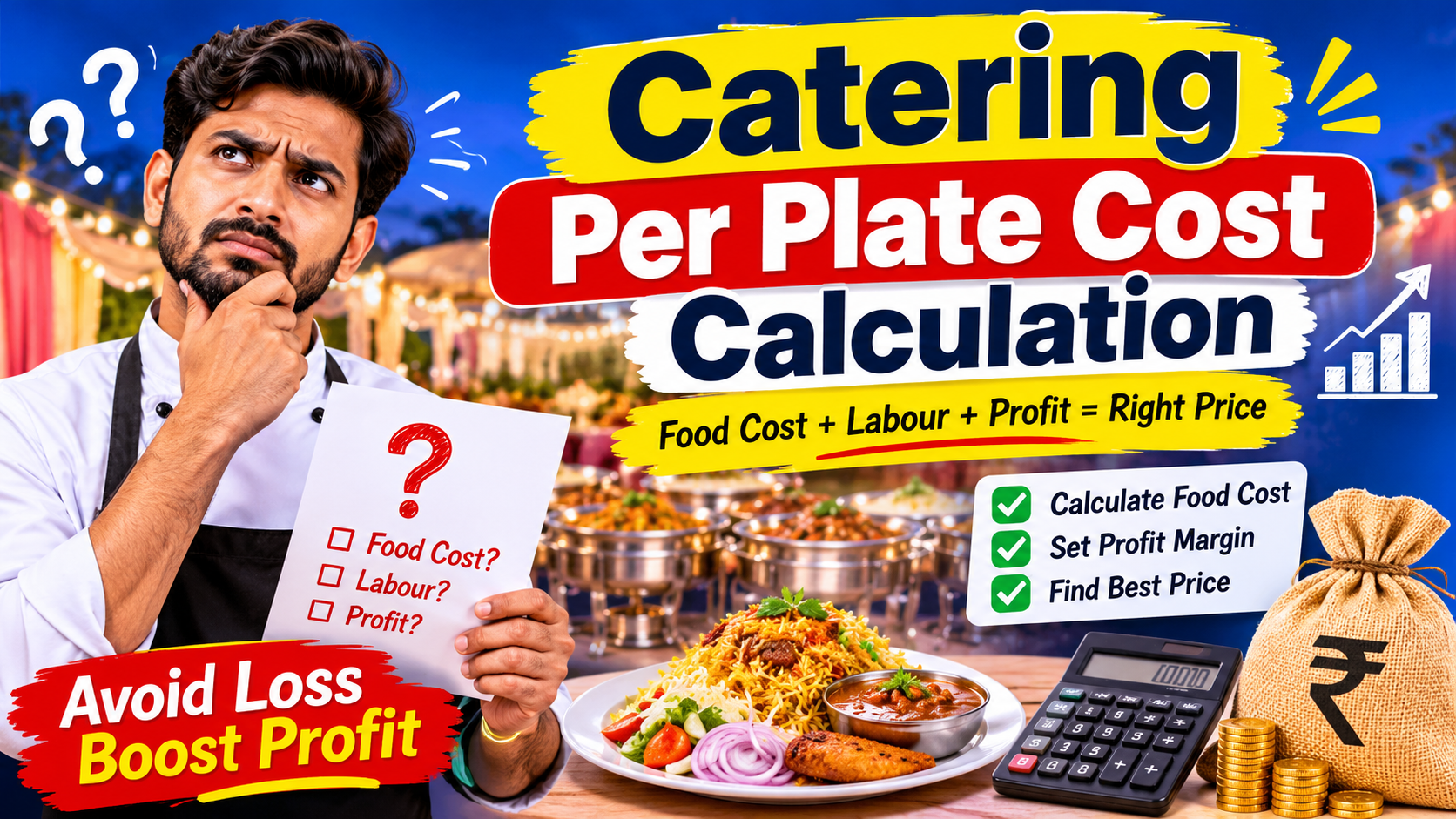
Catering Per Plate Cost Calculation: Food Cost, Labour & Profit Formula
Learn how Indian caterers can calculate the true cost per plate using recipe quantities, supplier rates, fuel, labour, transport, crockery and overhead. Includes a worked 300-plate example, margin formula and practical cost-sheet columns.

मेहंदी आर्टिस्ट अपनी ब्राइडल बुकिंग और टीम कैसे मैनेज करें?
Key Takeaways & Executive Summary
The main points at a glance
- Cost every dish from recipe quantities and current supplier rates, not memory.
- Keep portions prepared separate from plates the client will be billed for.
- Include fuel, labour, transport, crockery, equipment and allocated overhead.
- Divide total event cost by billable plates to find the true cost per billed plate.
- Use cost ÷ (1 − target margin) to calculate a selling price for a chosen margin.
- Compare estimated and actual event costs after every function.
- 1.Separate food cost from the full event cost
- 2.Calculate portions separately from billable plates
- 3.Work out ingredient cost dish by dish
- 4.Add labour, fuel, transport and equipment
- 5.Worked example: 300 billable plates
- 6.Set a selling price using margin—not guesswork
- 7.Recalculate each guest-count slab
- 8.Catering cost sheet format
- 9.Turn the cost sheet into a consistent quotation
- 10.Frequently Asked Questions
Separate food cost from the full event cost
Ingredients are only one part of delivery
Food cost covers the ingredients used in the menu. A catering booking also consumes fuel, labour, transport, crockery, equipment and business overhead.
Keep variable costs separate from fixed or step-based costs such as supervisors, vehicles and counter setups.
- Ingredients and raw material
- Fuel and utilities
- Kitchen and service labour
- Transport and loading
- Crockery, consumables and equipment
- Allocated business overhead
“Do not price an event using ingredient cost alone.”
Calculate portions separately from billable plates
Production quantity is not always the contract quantity
Estimate a preparation buffer using your own menu, venue and past event records. Any percentage used in an example is illustrative, not a universal rule.
For kitchen planning, calculate portions to prepare. For pricing, divide the full event cost by the plates the client will be billed for, subject to the agreed minimum guarantee.
- Production quantity = billable plates × (1 + preparation buffer %)
- Record minimum guarantee and final billable count separately
“Cost for the kitchen; price for the contract.”
Work out ingredient cost dish by dish
Use recipe quantities and current supplier rates
Record each ingredient quantity required for the planned production count. Convert pack sizes into consistent kilograms, litres or units before multiplying by current purchase rates.
Include every component of the dish—not just its main ingredient—and update rates when suppliers change prices.
- Ingredient line cost = required quantity × current unit rate
- Total ingredient cost = sum of all ingredient line costs
“A remembered market rate is not a reliable costing input.”
Add labour, fuel, transport and equipment
Capture the cost of delivering the event
Add event-specific wages, fuel, vehicle and equipment hire. Allocate shared staff, equipment and overhead consistently so they are not silently ignored.
Record the source and date of each estimate so you can revise it before sending a quotation.
- Halwai, kitchen and service team wages
- Fuel, utilities, loading and unloading
- Transport, crockery and consumables
- Live-counter equipment and overhead
“If the event needs it, the estimate should account for it.”
Worked example: 300 billable plates
Illustrative calculation, not a market rate
Assume 300 billable plates and 315 prepared portions. For illustration, ingredient cost is ₹48,825; fuel ₹4,500; labour ₹18,000; transport ₹4,500; crockery and consumables ₹3,000; equipment hire ₹4,000; and allocated overhead ₹6,000.
Total estimated event cost is ₹88,825. Divide by 300 billable plates: ₹88,825 ÷ 300 = approximately ₹296.08 per billed plate.
At a quote of ₹380 per plate, revenue is ₹1,14,000 and the difference before tax and any omitted costs is ₹25,175. These figures demonstrate the method only; they are not market rates or guaranteed profit.
- Use actual supplier bills and wage rates
- Keep production count separate from billable count
- Label every assumption
“The example is a method demonstration, not a recommended price.”
Set a selling price using margin—not guesswork
Know your break-even rate and target margin
Break-even rate per plate equals total estimated event cost divided by billable plates.
For a target margin, selling price equals cost per plate divided by (1 − target margin). Margin is different from markup.
- Break-even = total event cost ÷ billable plates
- Selling price = cost per plate ÷ (1 − target margin)
“A 20% markup is not the same as a 20% margin.”
Recalculate each guest-count slab
Costs do not all scale at the same rate
Build separate estimates for the guest counts you commonly quote. Recalculate recipes, staff, vehicles, counters, equipment and overhead for each slab.
A larger booking may reduce some costs per plate but may also need extra counters, vehicles or shifts. Price menu additions and live counters as visible line items.
- Recheck ingredient quantities
- Review staff and vehicle requirements
- Price live counters and extras separately
“A larger guest count does not automatically reduce every cost per plate.”
Catering cost sheet format
Keep assumptions beside the figures
Use one row per dish or expense and record the quantity, unit, current rate, line total, supplier and date checked.
At the bottom, summarise billable plates, preparation buffer, total event cost, break-even rate, target margin and final quote.
- Cost category and dish or expense
- Quantity and purchase unit
- Current unit rate and line total
- Supplier, date checked and assumptions
“A cost sheet should be understandable by the next person who opens it.”
Turn the cost sheet into a consistent quotation
Make sure the client quote matches the estimate
Confirm menu version, minimum billable quantity, extra-plate rate, service hours, live counters, transport, equipment and payment milestones before sending the proposal.
After the event, compare estimated costs with actual spending. Use the difference to improve the next estimate.
- Confirm inclusions and exclusions
- Record menu and guest-count changes
- Review estimated versus actual costs
“The event's actual cost is the feedback loop for your next quote.”
Frequently Asked Questions
Direct Answers & Industry Standards
Q:How do I calculate catering cost per plate?
Add ingredient, fuel, labour, transport, equipment, consumable and allocated overhead costs for the event. Divide the total by the number of plates you expect to bill.
Q:What is included in catering food cost?
Food cost covers ingredients used in the menu. Staff, fuel, transport, crockery, equipment and overhead are additional cost heads and should be included when calculating the full event cost.
Q:Should I divide by prepared portions or confirmed guests?
Use planned portions to calculate kitchen quantities. For the client-facing cost per billed plate, divide the complete event cost by the billable quantity set in the booking or minimum guarantee.
Q:How do I calculate a selling price with a 20% margin?
Divide the cost per billed plate by 0.80. This produces a 20% margin on sales; adding 20% to cost is a markup and gives a different result.
Q:Which expenses do caterers often miss?
Fuel, loading, overtime, supervisor time, vehicle hire, crockery breakage, cleaning supplies, live-counter equipment and a fair share of regular overheads are commonly overlooked.
Q:Should I use one rate for 300, 500 and 1,000 guests?
Not automatically. Ingredients scale with portions, while staff, vehicles, counters and equipment may change in steps. Build estimates for the guest-count slabs you regularly quote.

LaganBook Editorial Team
Verified Industry ExpertEvent Industry Analyst
The LaganBook Editorial Team publishes practical guides for Indian event-service and rental businesses, covering bookings, stock control, quotations, billing and day-to-day operations.
Experience Zero-Clash Bookings & 10-Second WhatsApp Quotes
Built for Indian tent house, DJ sound, and wedding decor businesses that want faster, smoother operations.
Recent Event Industry Articles
मेहंदी आर्टिस्ट अपनी ब्राइडल बुकिंग और टीम कैसे मैनेज करें?
बैंक्वेट हॉल और मैरिज गार्डन की बुकिंग कैसे मैनेज करें?
शादी के बैंड-बाजे का व्यवसाय कैसे संभालें?